


How Do Small Businesses Use Gift Cards?
Quick answer: In two different ways. Some small businesses sell their own branded gift cards to customers through a point-of-sale program (a cash-flow and loyalty play). Most use gift cards the other direction: buying cards to give out as employee rewards, client thank-yous, customer loyalty perks, and promotional incentives — with no minimum order, no procurement department, and a logo on the card for free. Ready to start? PerfectGift's small-business checkout has no minimum.
Small businesses use gift cards in two different ways, and it helps to know which one you mean. The first is selling their own branded gift cards to customers, a point-of-sale program that brings in cash up front and pulls people back into the store. The second is buying gift cards to give out, as employee rewards, client thank-yous, customer loyalty perks, and promotional incentives. This guide covers both, then focuses on the second, since that's where a small business can start today with no minimum order, no procurement department, and a logo on the card for free.
Two ways small businesses use gift cards
When a small business owner asks how to "use gift cards," they usually mean one of two very different things:
- Selling your own gift cards. You issue branded cards customers buy and redeem at your store, through your point-of-sale system. This is a cash-flow and loyalty play.
- Buying gift cards to give. You purchase cards, often Visa or Mastercard, or merchant brands, to hand out as rewards, gifts, and incentives to employees, clients, and customers.
| Selling your own gift cards | Buying gift cards to give | |
|---|---|---|
| What it is | You issue branded cards customers buy and redeem at your store | You purchase Visa, Mastercard, or merchant cards to hand out |
| Main benefit | Cash up front, repeat visits, and breakage on unredeemed cards | Rewards, recognition, gifts, and incentives |
| What you need | A point-of-sale or e-commerce platform | A card issuer or gifting provider, with no system setup |
| Best for | Stores, restaurants, and salons with a POS | Any small business rewarding people, from day one |
They solve different problems and use different tools. The section below covers selling briefly, then the rest of the guide is about buying to give, which is the faster, lower-commitment place for most small businesses to start.
Selling your own gift cards
If you run a store, restaurant, or salon, selling your own gift cards can be worth setting up. The appeal is mostly cash flow: a customer pays today for value they'll redeem later, which is effectively an interest-free advance, and a share of cards is never fully redeemed. Cards also bring new people through the door when they're given as gifts, and redeemers often spend beyond the card's value.
This runs through your point-of-sale or e-commerce platform — Square, Clover, Shopify, Toast, and similar systems offer built-in gift card features. It's a merchant program, not a product you buy from a gifting company, so if that's your goal, start with whatever POS system you already use. The rest of this guide is about the other path.
Buying gift cards to give
This is the path most small businesses reach for first, because it needs no system setup and works the same whether you're a team of three or thirty. The common use cases:
| Use case | What it looks like | Go deeper |
|---|---|---|
| Employee rewards & recognition | Spot bonuses, work anniversaries, holiday gifts, hitting a goal | Best gift cards for employees |
| Client & customer gifts | Year-end thank-yous, onboarding a new client, an apology or a favor returned | Gift cards for clients |
| Loyalty & promotions | Refer-a-friend rewards, spend-and-get offers, seasonal and win-back campaigns | Gift card promotion ideas |
| Buying at volume | Ordering many cards at once for any of the above | How to buy gift cards in bulk |
Across all of them, a Visa or Mastercard gift card fits a broad, mixed audience because the recipient chooses where to spend it, while a merchant brand card works when you know the person's taste. A branded card carries your logo either way.
What a small business needs from a gift card
Small businesses have the opposite constraints of a big enterprise: no procurement team, no six-figure order, and no weeks of lead time. The right solution is one an owner can run alone in an afternoon. That means a few specific things to look for:
A branded card punches above its weight for a small business specifically: for the cost of putting a logo on the card, a ten-person company can hand out a reward that looks every bit as considered as one from a Fortune 500.
How much should a small business spend, and what about taxes?
Two numbers come up constantly.
Client gifts. Most businesses spend $25 to $100 per client card, with $25 to $50 common for general appreciation and $100 or more for high-value clients or year-end gifts. The practical anchor is the IRS rule: business gifts are deductible only up to $25 per recipient per year, which is why many small businesses use $25 as a baseline and treat anything above it as relationship spend rather than a deduction.
Gift cards given to employees are treated by the IRS as taxable wages, regardless of amount, and belong on the employee's W-2. There's no de minimis exception for gift cards the way there is for a small physical gift like a holiday turkey. Budget for the tax, or gross it up so the reward keeps its intended value.
Confirm both with your accountant, since tax rules change and your situation may differ.
How to start giving gift cards in your small business
-
Pick the use case. Employee rewards, client gifts, customer loyalty, or a promotion. That choice sets the card type and the amount.
-
Choose the card. A Visa or Mastercard card for a mixed audience, so the recipient chooses where to spend, or a merchant brand card when you know their taste.
-
Add your logo. Upload a logo or design at checkout. With PerfectGift there's no setup fee, so the reward carries your brand from the first card.
-
Order self-serve. Buy one card or up to 50 through small-business checkout with no minimum, and use a free corporate account for larger orders.
-
Deliver and account for taxes. Send physical cards the same day or digital cards by email in minutes, treat employee cards as taxable wages, and note the $25-per-recipient limit on the client-gift deduction.
Where PerfectGift fits
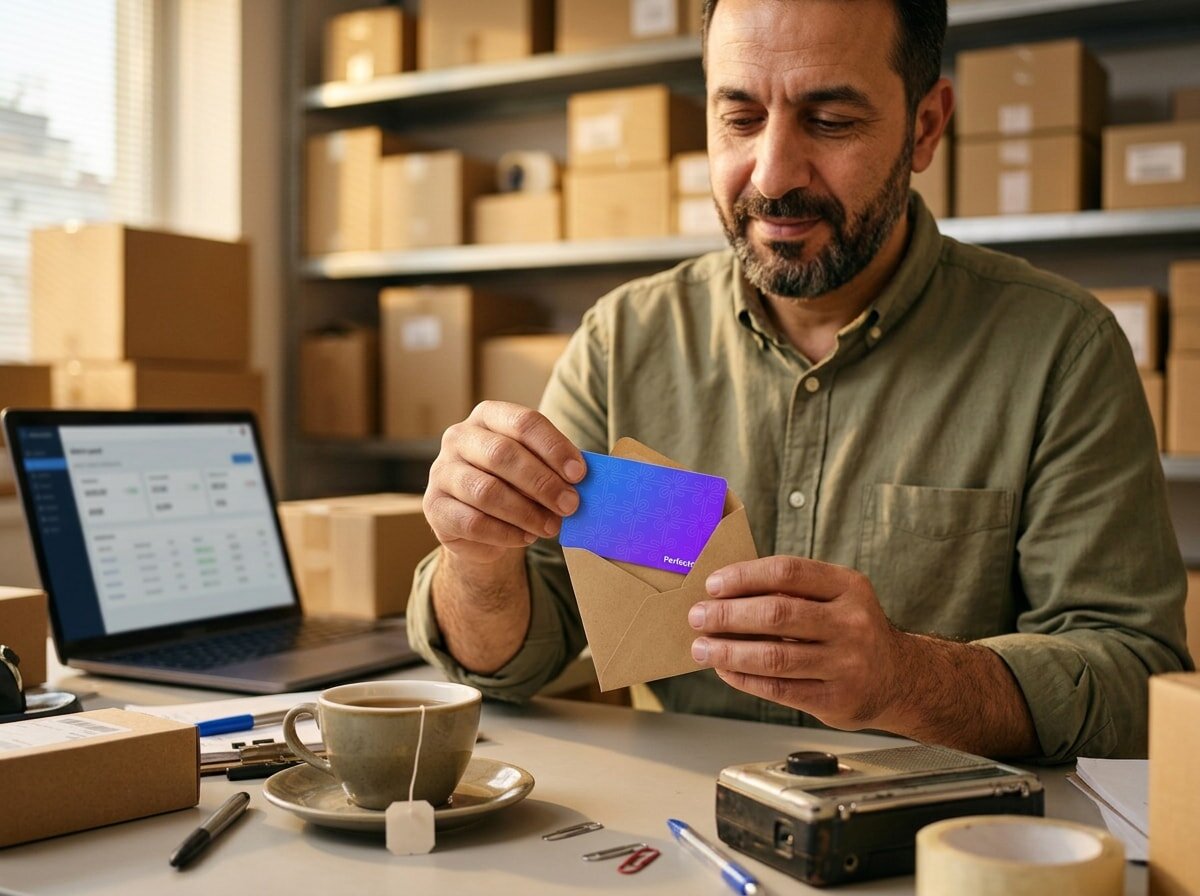
PerfectGift is built for the buying-to-give path, and its small-business setup is made for owners without a procurement department. You can order through a self-serve small-business checkout for up to 50 cards (a free corporate account unlocks larger orders and dedicated support), with no minimum and no setup fee. Adding your logo or a custom design to a physical or digital Visa card is free. Physical cards ordered before 4pm ET ship the same day, with next-day delivery available, and digital Visa and merchant eGift cards arrive by email within minutes, which suits remote teams and last-minute recognition. There are no activation, usage, or inactivity fees charged to the recipient for US use. PerfectGift Visa gift cards carry an expiration date printed on the front, with funds valid for at least five years from when the card is loaded, as federal law requires, and a replacement available if a balance remains at expiration. PerfectGift is US-only.
Ready to send your first branded gift card, no minimum required?
Start Small-Business Checkout on PerfectGift.com →Frequently asked questions
Two ways. They sell their own branded gift cards to customers through a point-of-sale system (a cash-flow and loyalty play), and they buy gift cards, Visa, Mastercard, or merchant brands, to give as employee rewards, client thank-yous, customer loyalty perks, and promotional incentives. Buying to give needs no system setup, so it's where most small businesses start.
With a direct issuer like PerfectGift there's no minimum. You can order a single card or up to 50 through small-business self-serve checkout; a free corporate account unlocks larger orders and dedicated support.
Yes. You can add a logo, brand colors, or a custom design to physical and digital Visa cards, with no setup fee and no minimum. It's what lets a small shop hand out a reward that looks as polished as a big brand's.
Yes. The IRS treats gift cards to employees as taxable wages at any amount, reportable on the W-2, with no de minimis exception. Client gifts are different: deductible as a business expense up to $25 per recipient per year. Confirm with your accountant.
Commonly $25 to $100, with $25 to $50 for general appreciation and $100 or more for high-value clients. The IRS $25-per-recipient deduction limit is why many businesses use $25 as a baseline.
Digital Visa and merchant eGift cards arrive by email within minutes. Physical cards ordered before 4pm ET ship the same day, with next-day delivery available.
They carry an expiration date printed on the front, but federal law requires the funds stay valid for at least five years from the date the card is loaded. If a balance remains at expiration, the recipient can request a replacement card.
