


Quick answer: A business can buy gift cards from five main sources: retail and warehouse stores, single-brand programs like Amazon Incentives and Walmart Business, gift card marketplaces and rewards platforms (Tango, Tremendous, Giftbit), banks and credit unions, and direct gift card issuers and corporate gifting providers like PerfectGift. Retail is fine for a quick one-off buy; a direct issuer is the best fit for branded, bulk, or gift-worthy cards. Start at perfectgift.com/corporate.
A business can buy gift cards from five main sources: retail and warehouse stores, single-brand programs like Amazon Incentives and Walmart Business, gift card marketplaces and rewards platforms (such as Tango, Tremendous, and Giftbit), banks and credit unions, and direct gift card issuers and corporate gifting providers like PerfectGift.
The right source depends on four questions:
- Do you need your logo or a custom design on the card?
- Are you buying in volume (dozens, hundreds, or thousands)?
- Do you want physical cards, digital delivery, or both?
- Should the card feel like a gift, or just function as a payout?
Short version: retail is fine for a quick one-off buy, single-brand and marketplace platforms are built for high-volume digital rewards, and a direct issuer like PerfectGift is the best fit when you need branded, bulk, or gift-worthy cards with your logo on them.
First, know which kind of card you're buying
Before you pick a source, settle one thing, because it decides most of the rest: open-loop or closed-loop.
- Open-loop cards carry a Visa or Mastercard logo and work anywhere those networks are accepted. The recipient chooses where to spend, which is why open-loop is the safe default when you're gifting across a team or a client list and can't guess anyone's taste.
- Closed-loop cards are tied to one brand (an Amazon or Walmart card, for example). They're a stronger signal when you know the recipient loves that retailer, and a narrower gift when you don't.
A reward that carries your logo and arrives as a gift signals recognition. A bare code in an inbox signals a transaction. For employee and client programs, that difference is the program, so it belongs in the buying decision, not after it.
The 5 places a business can buy gift cards
1. Retail and warehouse stores
The racks at grocery, drugstore, and big-box stores are the fastest way to grab a few cards, and warehouse clubs like Costco and Sam's Club sell popular-brand multipacks at a small discount (often 5–10% off, with a membership).
The ceiling arrives quickly. Open-loop Visa and Mastercard cards carry per-card caps (commonly up to $500) and per-customer, per-day purchase limits, activation fees apply, you can't add your logo, and there's no account, reporting, or bulk ordering. Use retail when you need a handful of cards today, not when you're running a program.
2. Single-brand business programs (Amazon Incentives, Walmart Business)
Several large retailers sell their own cards to businesses directly. Amazon Incentives lets you open an account (approval usually takes one to three business days), then order Amazon cards in bulk through a portal or API, with volume pricing, no recipient fees, no expiration, and optional logo branding. Walmart Business offers bulk Walmart cards in physical and digital form.
Pick these when you specifically want to give that retailer's card. The trade-off is reach: the reward only spends in one place, so it asks you to know the recipient's preference in advance.
3. Gift card marketplaces and rewards platforms
Rewards-as-a-service platforms such as Tango, Tremendous, and Giftbit are built to send digital rewards at scale. They carry large multi-brand catalogs (Tango lists 3,100+ brands, Tremendous 2,000+, Giftbit 1,500+), deliver by email, SMS, or link, and connect to HR and survey tools through APIs and prebuilt integrations. Several handle international delivery across dozens of countries.
These platforms fit when you're sending high-volume, global, or cash-like payouts, such as survey incentives, research panels, or mass rebates. The trade-off is that the recipient gets a link, not a gift. For recognition and client appreciation, where the presentation is doing real work, a link tends to feel like a payout.
4. Banks and credit unions
Some banks and credit unions sell open-loop Visa or Mastercard gift cards at the branch. They're a legitimate way to pick up a few general-purpose cards, but selection is thin, purchase fees are common, quantities are capped, and there's no branding or bulk ordering. It's rarely the right channel once you're buying at any scale.
5. Direct gift card issuers and corporate gifting providers
A direct issuer sells to businesses without a retail middleman, and that's what unlocks branding, bulk, custom amounts, and program tools. The category runs from pure digital payout providers to premium gifting platforms. PerfectGift sits at the gifting end: open-loop Visa and Mastercard cards you can put your logo on, physical or digital, at volume, with the presentation and support of a corporate gifting program behind them. More on where PerfectGift fits below.
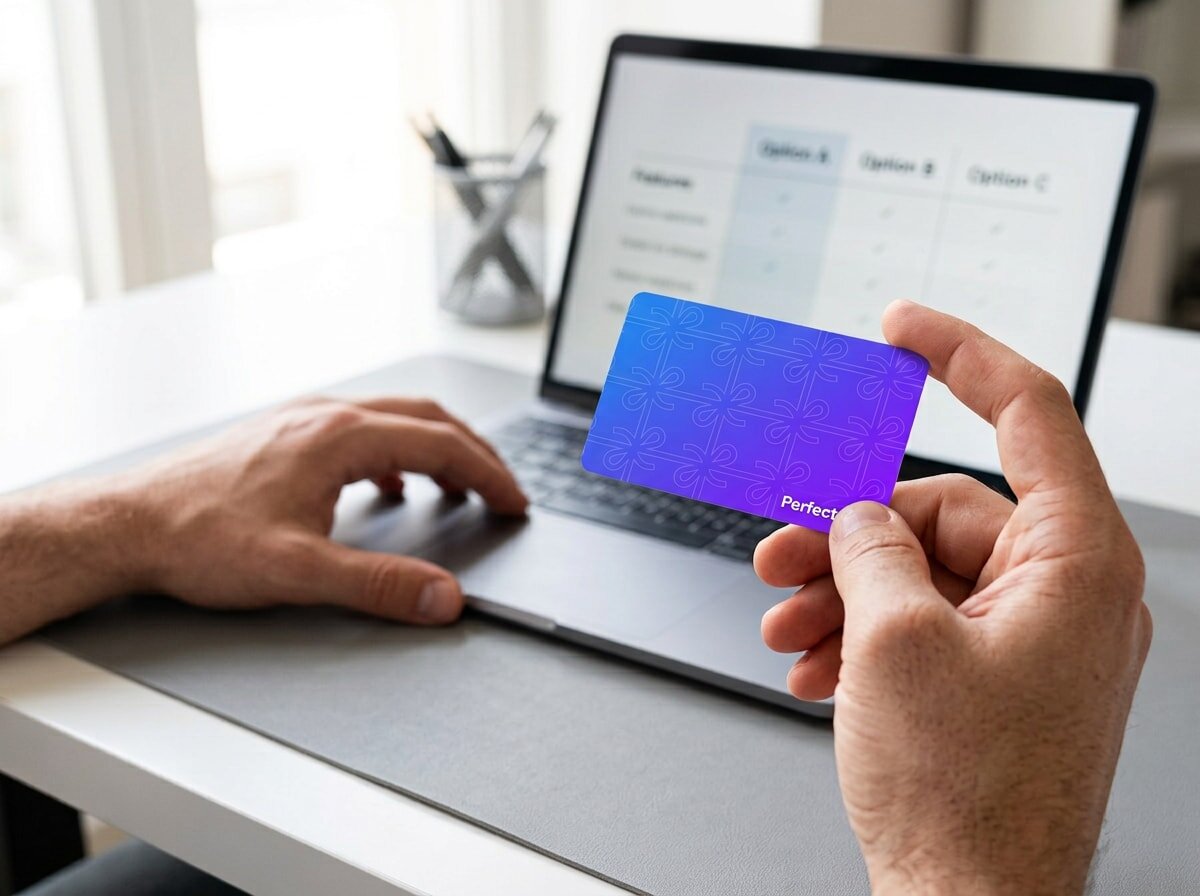
Compare the options at a glance
| Source | Best for | Custom branding | Bulk-friendly | Physical or digital | Feels like a gift |
|---|---|---|---|---|---|
| Retail & warehouse | A quick, one-off handful of cards | No | No (per-day caps) | Physical | Low |
| Amazon / Walmart programs | Giving one specific retailer's card | Logo only | Yes | Both | Medium (single brand) |
| Rewards platforms (Tango, Tremendous, Giftbit) | High-volume or global digital payouts | Limited | Yes | Digital | Low (link-based) |
| Banks & credit unions | A few general-purpose cards | No | No | Physical | Low |
| Direct issuer (PerfectGift) | Branded, bulk, gift-worthy cards | Yes (logo or full custom) | Yes | Both | High |
How to choose the right source for your use case
- Employee recognition and appreciation: you want the reward to feel personal, so a branded or personalized card from a direct issuer does more than a bare link. They pick the brand, you get the credit. See best gift cards for employees.
- Client and holiday gifting: presentation carries the relationship, so a co-branded card in a carrier or greeting card feels like a gift, not a transaction. See custom & branded gift cards for business.
- Promotions, giveaways, and referrals: you need volume and speed, usually digital, and branding lets the card double as marketing. A direct issuer or a rewards platform both work. See gift cards for promotions & giveaways.
- Research incentives, rebates, or global payouts: high volume, often cash-like or international, is where a rewards platform is strongest.
- Buying in bulk: the economics and the ordering differ by channel. See how to buy gift cards in bulk.
Why businesses buy gift cards from PerfectGift
If the reward should look like it came from you and still scale to a full team or client list, that's the problem PerfectGift is built to solve. Here's what you get:
Small business: no minimum, self-serve. Put your logo on a Visa card or send merchant-branded cards in bulk, with no program setup.
Corporate programs ($10,000+): full custom and co-branding, API access, and dedicated support for larger recognition, gifting, and incentive programs.
PerfectGift is US-only, and our curated catalog of 300+ national brands is smaller than the multi-thousand-brand lists the global payout platforms carry. If you're running international payouts or need the widest possible brand count, a global rewards platform may fit you better. If the reward should look and feel like a gift, that's the trade we make on purpose.
How to buy gift cards for your business from PerfectGift
-
Choose the card. An open-loop Visa or Mastercard your recipient can spend anywhere, or a PerfectGift+ card that lets them pick from 300+ brands, swap to Visa/Mastercard, or cash out via Zelle.
-
Add your brand. Drop your logo onto a preset design or upload a full custom design. Add a message, and a carrier or greeting card if you want the physical presentation.
-
Set amounts and quantities. Pick your denominations and how many you need. Small orders are self-serve with no minimum; programs of $10,000+ move to a dedicated corporate path with API access.
-
Choose delivery. Digital by email or text in minutes, or physical shipped the same day when you order before 4pm ET.
-
Send and track. Distribute in bulk and track activation and redemption, through the dashboard or the API for ongoing programs.
Start at perfectgift.com/corporate.
Ready to buy gift cards that carry your brand?
Start Your Order on PerfectGift.com →Frequently asked questions
From retail and warehouse stores, single-brand programs like Amazon Incentives and Walmart Business, rewards platforms such as Tango, Tremendous, and Giftbit, some banks and credit unions, and direct issuers and corporate gifting providers like PerfectGift. A direct issuer is the best fit for branded, bulk, or gift-worthy cards.
A small business can use retail for a quick handful, but for branded or bulk cards a direct issuer is the better route. PerfectGift's small-business option is self-serve with no minimum, so you can put your logo on a Visa card or send merchant-branded cards in bulk without setting up a formal program.
Yes. Direct issuers, single-brand business programs, and rewards platforms all support bulk orders. Retail racks generally don't, because open-loop cards carry per-customer, per-day purchase limits.
Yes, through a direct issuer. PerfectGift lets you add your logo to a Visa or Mastercard card, or upload a full custom design, at no extra charge. Retail and bank cards can't be branded.
Open-loop Visa cards are sold at retail and some banks in small quantities, and by direct issuers like PerfectGift for branded and bulk orders. A direct issuer is the only route that allows a custom logo, custom amounts, and volume ordering.
Sometimes. Warehouse clubs sell brand multipacks at a small discount, and programs like Amazon Incentives offer volume-based pricing. Terms vary by provider and order size.
It depends on the source and card type. Retail open-loop cards typically charge an activation fee. PerfectGift charges no recipient-side fees in the US; a 3% surcharge applies if you pay by credit card.
Yes. Direct issuers and rewards platforms both deliver digitally by email, text, or link, usually within minutes, which suits last-minute or remote recipients.
